
Ibiza and Formentera are best experienced from the water. By road, you catch glimpses. By yacht, the coastline opens up properly, hidden coves, long stretches of white sand, dramatic cliffs, and anchorages that feel completely different when you arrive by sea.
Cruising along Ibiza’s west coast, you pass turquoise bays framed by pine-covered hills and rocky headlands. Head south and the scene shifts to beach clubs and wide sandy stretches. Continue across to Formentera and the water turns impossibly clear, shallow, and bright, more Caribbean than Mediterranean. Drop anchor and you step straight into open water, no crowds, no queues, no walking down dusty paths in the heat.
In a single day, you can move between lively beach atmospheres and quiet, untouched coves. Swim in calm shallows, cruise past iconic landmarks, stop for lunch with your feet almost in the sea, then finish with a slow sunset run back towards Ibiza.
If you want to experience both islands properly, exploring them by yacht is what makes it seamless. Discover our Ibiza yacht charter options and plan a day that flows exactly how you want it to.
Sunset anchoring – Cala Conta and the waters around Es Vedrà offer some of the best golden-hour views in Ibiza.
Swimming & snorkelling – Cala Salada in Ibiza and Cala Saona in Formentera both provide clear water and excellent visibility.
Beach club atmosphere – Cala Jondal and Ses Salines are ideal for anchoring offshore before heading in for lunch.
Quiet escape – The northern coves of Ibiza or the quieter stretches of Playa de Llevant in Formentera offer more privacy.
White sand & shallow water – Ses Illetes in Formentera is famous for its bright turquoise, flat anchoring areas.
Full day island-hopping route – Combine Ibiza’s west coast with a cruise across to Formentera for a varied and relaxed charter day.
Generally calm summer seas – Between Ibiza and Formentera the water is often flat and ideal for cruising during settled weather.
Sheltered anchorages – Ibiza’s west coast bays provide protection depending on wind direction, while Formentera offers wide, sandy holding areas.
Popular anchoring zones – Cala Conta, Cala Jondal and Ses Illetes become busy in peak season, best visited earlier or later in the day.
Depth considerations – Many anchorages range from 4 to 12 metres, with sandy seabeds around Formentera particularly well suited for secure anchoring.
This gives you a quick way to plan your route before exploring each beach and anchorage in more detail below.
Cala Conta (Platges de Comte)
West coast, iconic sunset anchorage, turquoise water, small island views.
Cala Bassa
Easy anchoring, relaxed beach club atmosphere, good for lunch stops.
Cala Salada
Clear water, more natural feel, great swimming and snorkelling.
Cala Jondal
Premium crowd, beach clubs, larger yachts often anchor offshore.
Ses Salines
Long sandy stretch, social scene, popular south-coast stop.
Cala d’Hort
Best views of Es Vedrà, dramatic backdrop, scenic anchorage.
Ses Illetes
White sand, shallow turquoise water, Caribbean-style anchoring.
Cala Saona
Red cliffs, calm bay, protected anchorage.
Playa de Llevant
Quieter alternative to Illetes, long open stretch, good holding.
Es Pujols (Anchorage Area)
Lively but less intense than Ibiza, good swimming and lunch stop option.
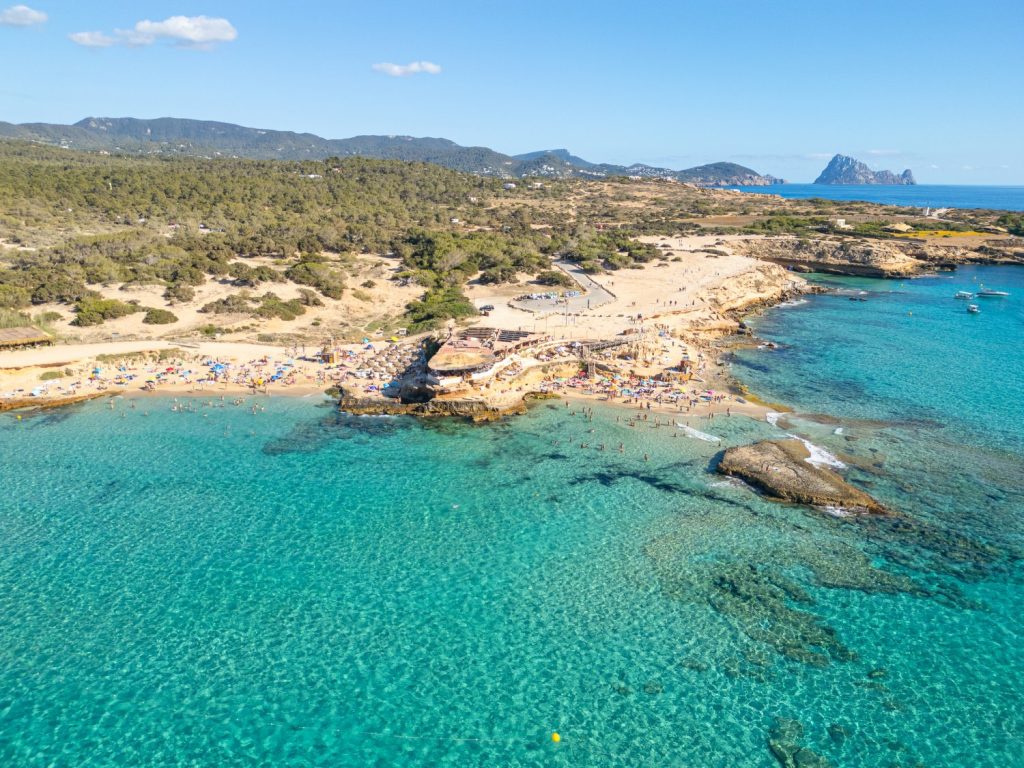
Cala Conta is one of those beaches that feels completely different when you approach it from the water. By land, it is busy and popular. By yacht, you arrive facing a wide sweep of turquoise water with small rocky islets scattered just offshore. The contrast between deep blue open sea and the bright, shallow anchoring area is striking.
Anchoring here gives you space. You sit just far enough off the beach to avoid the crowds, but close enough to swim straight in. The surrounding cliffs and island views create one of the most photogenic backdrops on Ibiza’s west coast, particularly as the light starts to soften later in the day.
Cala Conta works well for mixed groups, including families, couples and charter parties. The energy is sociable but not excessive, building gradually through the afternoon as sunset approaches. From the water, it feels lively without losing its relaxed west coast character.
Restaurants such as Sunset Ashram and S’Illa des Bosc sit above the shoreline, positioning Cala Conta as one of Ibiza’s more established sunset and lunch anchorages.
The water here is exceptionally clear, with bright turquoise shallows closer to shore and slightly deeper blue further out. The seabed is mainly sandy with some rocky patches, making it suitable for anchoring in the right spots.
It is excellent for swimming, floating, and paddleboarding. Snorkelling is decent around the rocky edges near the islets, where small fish tend to gather. Depth typically ranges between 5 to 10 metres in common anchoring areas.
Late afternoon is the highlight at Cala Conta, especially for sunset. The west-facing position makes it one of Ibiza’s most famous golden-hour locations.
For a quieter experience, arrive earlier in the morning before day boats and beach traffic build. Midday in peak summer can be busy, so positioning slightly further out gives you more space.
Cala Conta pairs well with a cruise past Es Vedrà later in the day, making it a natural first or final stop on a west coast charter route.
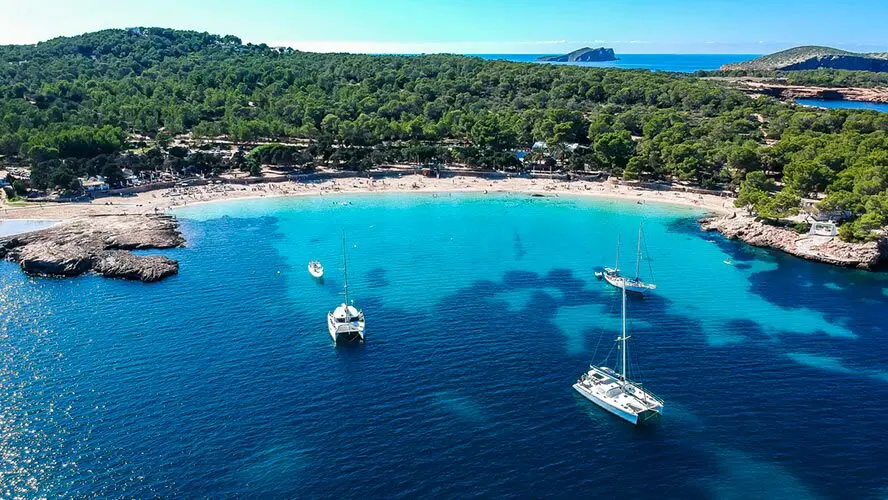
Cala Bassa is one of the easiest and most comfortable anchorages on Ibiza’s west coast. Approaching by yacht, you’re met with a wide, gently curving bay framed by low pine trees and soft golden sand. The water shifts from pale turquoise in the shallows to deeper blue further out, giving it that classic Mediterranean contrast.
By land, Cala Bassa is popular and accessible. By boat, it feels more relaxed. You anchor just offshore, away from the foot traffic, with the freedom to swim in or stay onboard and enjoy the view. The bay is broad and open, which makes manoeuvring and anchoring straightforward in settled conditions.
Cala Bassa is very family-friendly and easy to enjoy. It attracts a broad mix of families, couples and charter groups, with a relaxed, sociable atmosphere rather than a high-end or party-led scene. The energy is steady through the day without becoming overwhelming.
The shoreline is anchored by Cala Bassa Beach Club (CBbC), which defines the beach’s positioning as a comfortable, well-organised west coast lunch stop.
The seabed here is mostly sandy, offering good holding in suitable areas and making swimming comfortable underfoot. The water is clear and calm in the right wind direction, ideal for relaxed dips, paddleboarding and floating beside the yacht.
Snorkelling is better towards the rocky edges of the bay, where you’ll find more marine life. Depth in common anchoring zones generally ranges between 4 to 8 metres.
Late morning to early afternoon works well if you’re planning to stop for lunch. In peak summer months, it can get busy from midday onwards, so arriving earlier gives you better positioning.
It’s less of a sunset spot compared to Cala Conta, so many charters use Cala Bassa as a midday anchorage before cruising elsewhere for golden hour.
Cala Bassa combines well with Cala Conta in a west coast route, making it an easy two-stop sequence on a 6 to 8 hour charter.
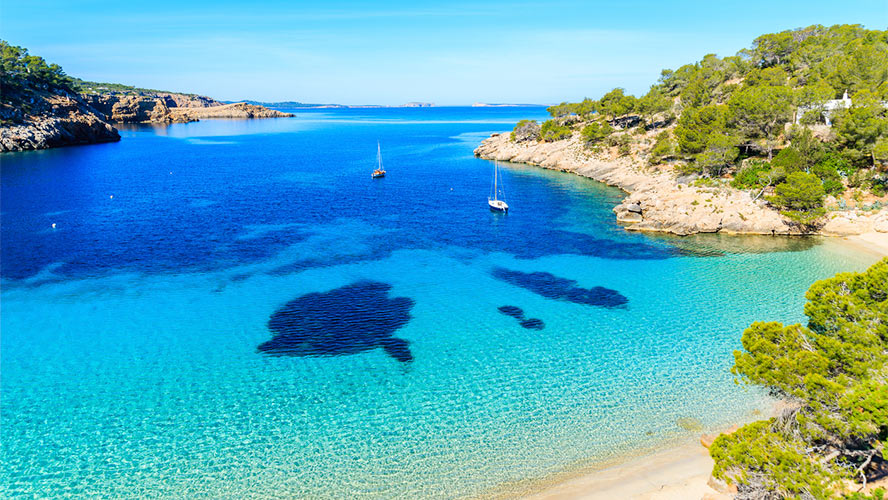
Tucked into Ibiza’s west coast, Cala Salada offers a noticeably quieter and more untouched alternative to the island’s headline beaches. Arriving by yacht, you approach a compact bay framed by pine-covered hills and warm-toned cliffs. The water here is strikingly clear, with a rich turquoise tone that deepens as you move away from shore.
By road, access can be limited and parking tightly controlled in summer. By boat, you bypass all of that and arrive directly into open water. Anchoring just outside the main swimming area gives you a peaceful vantage point looking back at untouched greenery rather than rows of umbrellas.
Cala Salada is quieter and more natural than many of Ibiza’s better-known beach club destinations. It appeals to families, couples and charter guests looking for scenery and swimming rather than a social scene. The overall energy is calm, particularly earlier in the day, with a more traditional and understated feel.
There is a small, traditional restaurant overlooking the bay, but Cala Salada is not defined by beach clubs, which reinforces its more authentic, less commercial character.
This is one of the best swimming spots on the west coast. The water clarity is excellent, and the rocky seabed near the edges of the bay makes it good for snorkelling.
There are sandy patches for anchoring, but you need to position carefully to avoid rocky areas and protected zones. Typical anchoring depth is around 6 to 12 metres depending on how far off you sit.
Morning is ideal. The water is often flatter and the bay feels more private before the day traffic builds.
Mid-afternoon in peak summer can become busy with smaller boats, so many charters use Cala Salada as an early swim stop before heading further south or towards sunset locations.
Cala Salada works particularly well as the first stop of the day before cruising towards Cala Bassa or Cala Conta later in the afternoon.
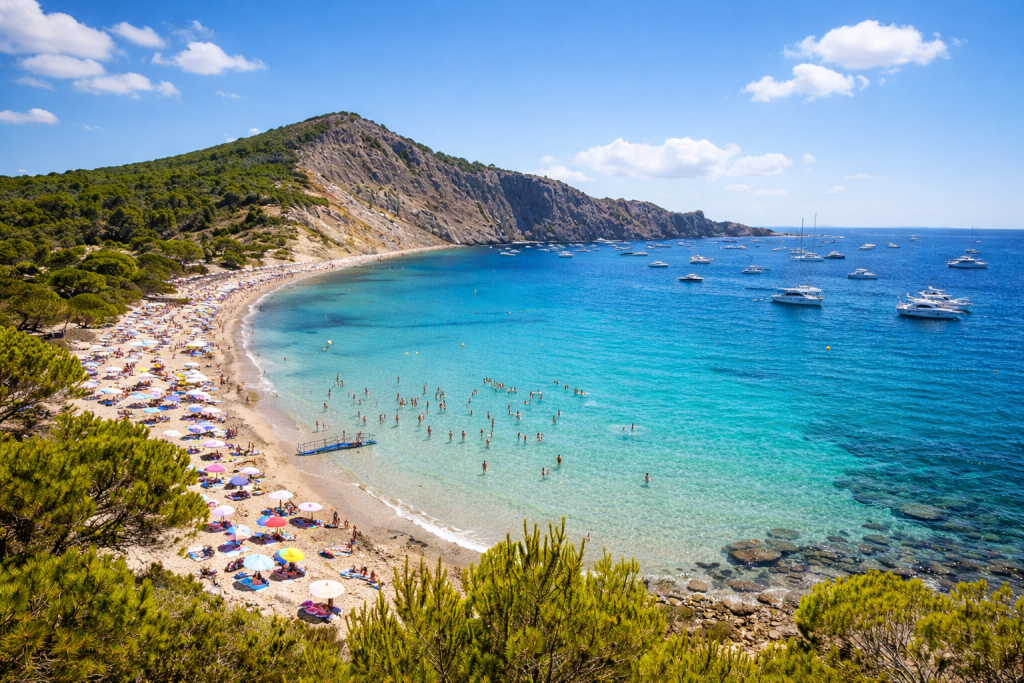
On Ibiza’s south coast, Cala Jondal shifts the mood entirely, from quiet coves to a more polished, social anchorage. Approaching by yacht, you’re met with a long, sweeping bay framed by low cliffs and darker pebble shoreline. The water is deep blue and clear, and the anchorage sits slightly further offshore than many west coast coves, giving it a more open feel.
By land, Cala Jondal is known for traffic and reservations. By yacht, you arrive directly into the bay, anchor comfortably, and tender ashore if you have lunch booked. It’s a stop that feels designed for boats, with large yachts regularly positioned across the anchorage.
Cala Jondal has a distinctly premium, social energy. It attracts a well-dressed, international crowd, with a mix of larger yachts and day charters anchoring offshore. The atmosphere builds steadily through the afternoon and feels polished rather than chaotic.
The shoreline is home to Casa Jondal and Blue Marlin, positioning Cala Jondal as one of Ibiza’s most recognised high-end lunch and beach club anchorages.
The water is clear and refreshing, though the seabed is more pebbled and rocky than sandy. Good holding can be found in appropriate sandy patches, but positioning is important.
Depth typically ranges from 8 to 15 metres depending on how far out you anchor. Swimming is enjoyable but this is less of a snorkelling cove and more of a social swim-and-lunch stop.
Late morning to early afternoon is ideal if you’re planning a beach club lunch. The anchorage becomes busier from midday in peak summer.
If you prefer a calmer feel, arrive earlier before the larger yachts and day boats settle in. Cala Jondal is not a sunset location, so most charters move on later in the day.
Cala Jondal pairs well with Ses Salines or a cruise towards Formentera, making it a natural southern stop on a full-day island-hopping charter.
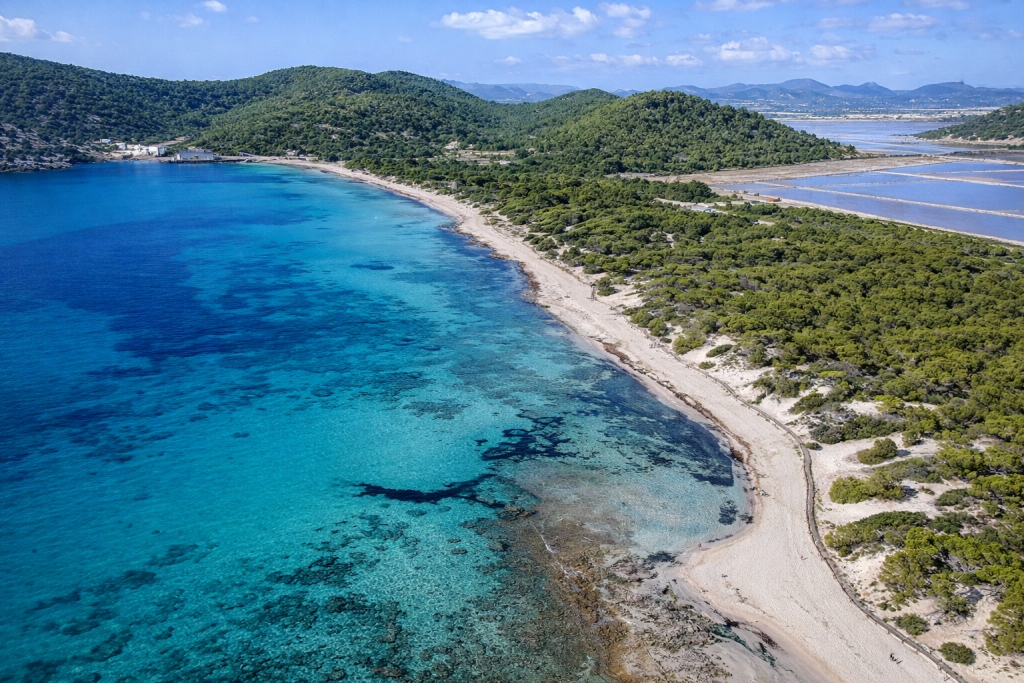
Ses Salines is one of Ibiza’s longest and most recognisable beaches, stretching in a wide arc along the south coast. Approaching by yacht, you see a broad strip of pale sand backed by dunes and low greenery, with open sea extending towards Formentera in the distance.
Unlike the tighter west coast coves, Ses Salines feels expansive. You anchor further offshore in open water, giving you uninterrupted views of the coastline. By road, it can be crowded and busy in peak season. By yacht, you sit just beyond it all, with the freedom to swim, relax, or head ashore on your own terms.
Ses Salines has a lively, open energy and attracts a mix of beachgoers, day boats and charter yachts throughout the summer. It is social rather than exclusive, with a broad crowd and a steady build in atmosphere as the day progresses. From the water, the long stretch of sand keeps it feeling spacious even at busier times.
Established venues such as Jockey Club and Beso Beach Ibiza sit along the shoreline, reinforcing Ses Salines as one of the island’s classic south-coast lunch and beach club stops.
The water is generally clear with a sandy seabed, especially closer to shore. Holding can vary in places due to seagrass protection areas, so careful anchoring is important.
Depth typically ranges from 6 to 14 metres in common anchoring zones. Swimming is comfortable and open, with plenty of room to float or paddleboard around the yacht.
Late morning to early afternoon works well if you’re planning to stop for lunch. In peak season, it becomes busy by midday, so earlier arrival gives better positioning.
It is less about sunset and more about daytime atmosphere, with many charters using it as a southern stop before crossing towards Formentera.
Ses Salines combines naturally with Cala Jondal or a short cruise across to Ses Illetes in Formentera for a varied island-hopping day.
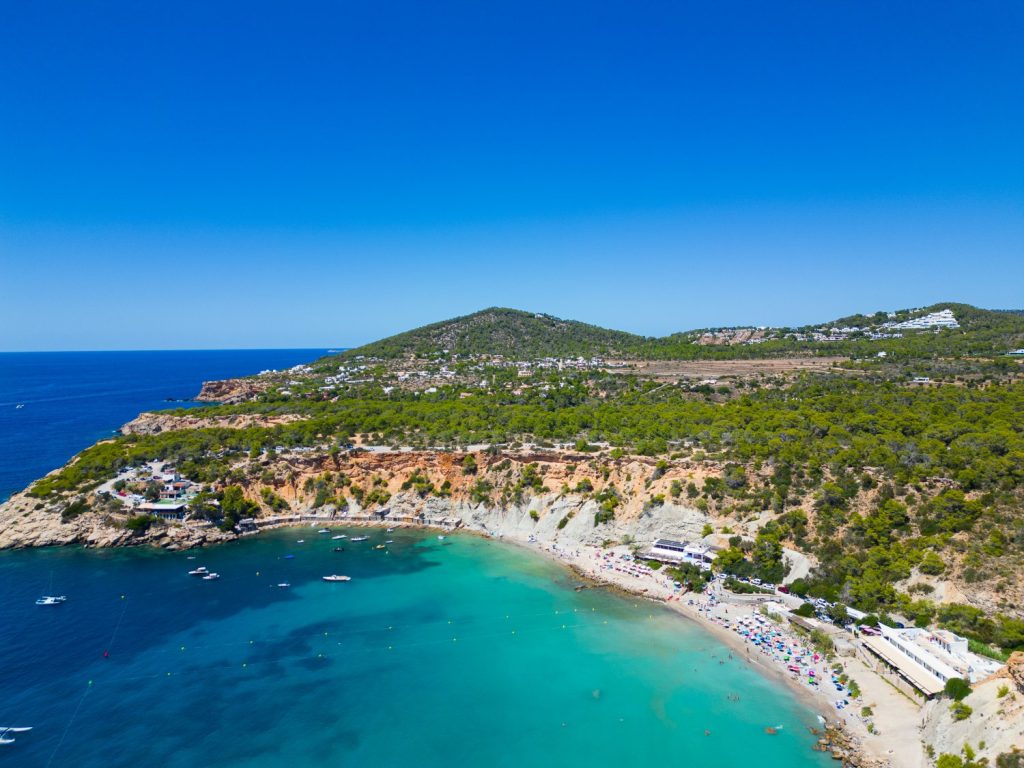
Cala d’Hort is all about the view. As you approach by yacht, the towering outline of Es Vedrà rises dramatically from the sea just offshore. The beach itself is smaller and more rugged than others, but the backdrop is what makes this anchorage unforgettable.
By land, Cala d’Hort is known for its viewpoint and restaurants. By yacht, you sit directly facing one of Ibiza’s most iconic landmarks. Anchoring here gives you uninterrupted sightlines towards Es Vedrà and Es Vedranell, with open water and a more dramatic feel than the softer bays further north.
Cala d’Hort feels more scenic than social. It attracts families, couples and charter guests drawn primarily by the view of Es Vedrà rather than a beach club scene. The overall energy is relaxed and traditional, with most visitors focused on the setting rather than the party atmosphere found elsewhere on the island.
Restaurants such as El Carmen and Restaurante Cala d’Hort overlook the bay, positioning it as a classic, view-driven lunch stop rather than a high-energy beach club destination.
Water & Swimming
The water is clear and refreshing, though the seabed is a mix of sand and rock. Careful positioning is important when anchoring to avoid rocky patches and protected seagrass.
Depth generally ranges between 8 to 15 metres depending on how far out you anchor. Swimming is enjoyable, and the surrounding rock formations create an impressive natural setting while you’re in the water.
Late afternoon is ideal, particularly if you plan to continue towards Es Vedrà for sunset. The changing light across the rock formation is what makes this area special.
Midday can be busier in peak summer, so arriving slightly earlier or later helps avoid congestion.
Anchor with Es Vedrà positioned directly ahead of the bow for the best perspective and photographs.
Cala d’Hort pairs perfectly with a slow cruise around Es Vedrà towards golden hour, making it a strong scenic stop on a west or south-west coast charter route.
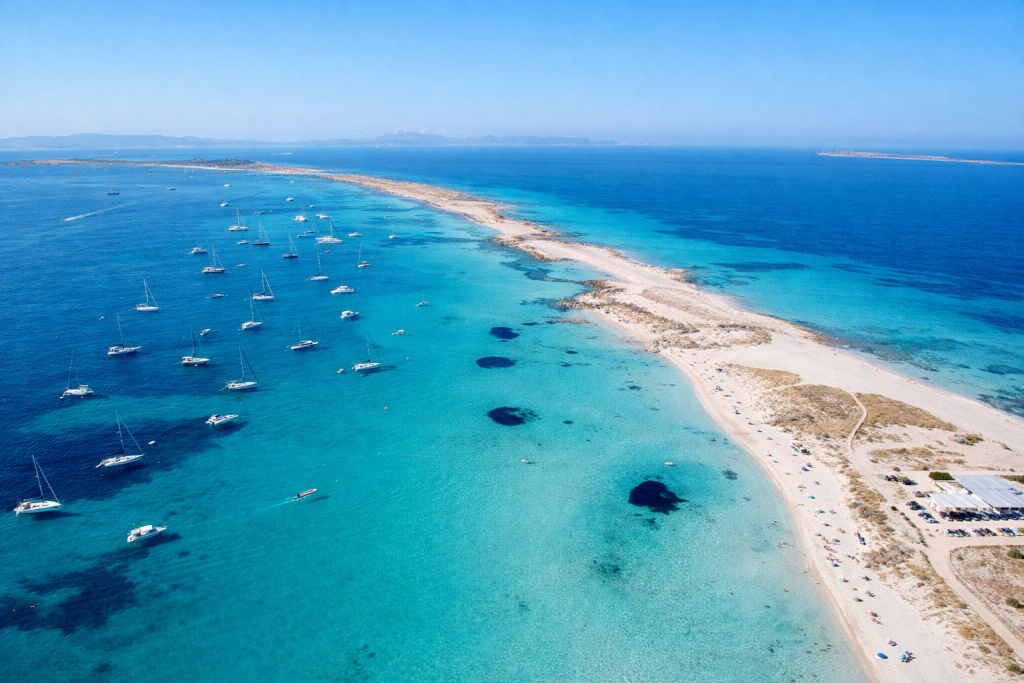
Ses Illetes is the reason many charters cross from Ibiza to Formentera. Approaching by yacht, the water becomes noticeably lighter, shifting from deep blue to bright, shallow turquoise. Long stretches of white sand sit between open sea on one side and calm lagoon-like water on the other.
By land, it is beautiful. By boat, it feels extraordinary. You anchor in clear, shallow water with visibility all the way to the seabed. The positioning allows you to swim straight off the back of the yacht into water that feels almost tropical. It is one of the most visually striking anchorages in the Balearics.
Ses Illetes has a refined but lively atmosphere, attracting a mix of charter yachts, day boats and visitors crossing from Ibiza. It feels polished rather than chaotic, with a steady build in energy through the afternoon while still maintaining a relaxed, open setting due to the beach’s length.
Restaurants such as Juan y Andrea and Beso Beach Formentera line the shoreline, positioning Illetes as the island’s most established and recognisable yacht-lunch destination
This is some of the clearest water in the region. The seabed is mostly sand with protected seagrass areas, so anchoring must be done carefully and in permitted zones.
Depth in common anchoring areas typically ranges from 4 to 8 metres. Swimming conditions are excellent, with flat, calm water in settled weather and ideal conditions for paddleboarding.
Mid-morning is ideal if you want the most relaxed experience and best anchoring position. By midday in peak season, the anchorage becomes busy.
Early afternoon works well for lunch, while many charters depart before sunset to return comfortably to Ibiza.
Ses Illetes combines naturally with a stop at Cala Saona or a southern Ibiza anchorage, making it a highlight on any full-day island-hopping charter.
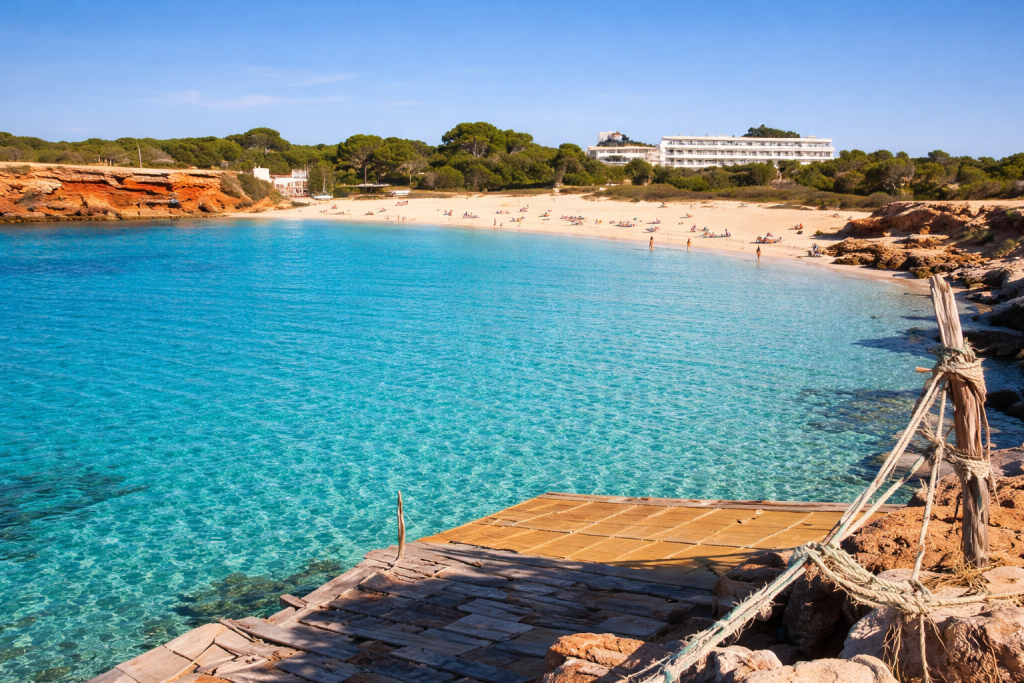
Cala Saona offers a completely different feel to Ses Illetes. As you approach by yacht, you enter a compact bay framed by warm red cliffs and low, rugged landscape. The colour contrast between the rock, the pale sand, and the bright turquoise water makes it one of Formentera’s most scenic anchorages.
By road, it feels tucked away. By boat, it feels protected and calm. The bay naturally shields you in the right conditions, and anchoring here gives you a more enclosed, intimate setting compared to the wide-open stretches of Illetes.
Cala Saona has a quieter, more relaxed atmosphere than Ses Illetes. It attracts families, couples and charter groups looking for a scenic swim stop rather than a beach club scene. The overall energy is calm and understated, particularly outside peak midday hours.
There are a small number of traditional restaurants overlooking the bay, including Restaurant Sol, reinforcing its positioning as a low-key, view-led lunch stop rather than a high-profile dining destination.
Water & Swimming
The water here is clear and generally calm in settled weather. The seabed is mostly sandy with some rocky edges near the cliffs.
Anchoring depths typically range from 5 to 10 metres depending on positioning. Swimming conditions are excellent, and the enclosed shape of the bay makes it feel sheltered and easy for relaxed floating and paddleboarding.
Late morning or early afternoon works well, particularly before the bay fills with smaller boats.
It can also be a beautiful late-afternoon stop when the sun starts to lower and the cliffs take on warmer tones. It is less about dramatic sunset and more about protected swimming conditions.
Cala Saona pairs well with Ses Illetes earlier in the day, creating a balanced Formentera route before cruising back towards Ibiza in the afternoon.
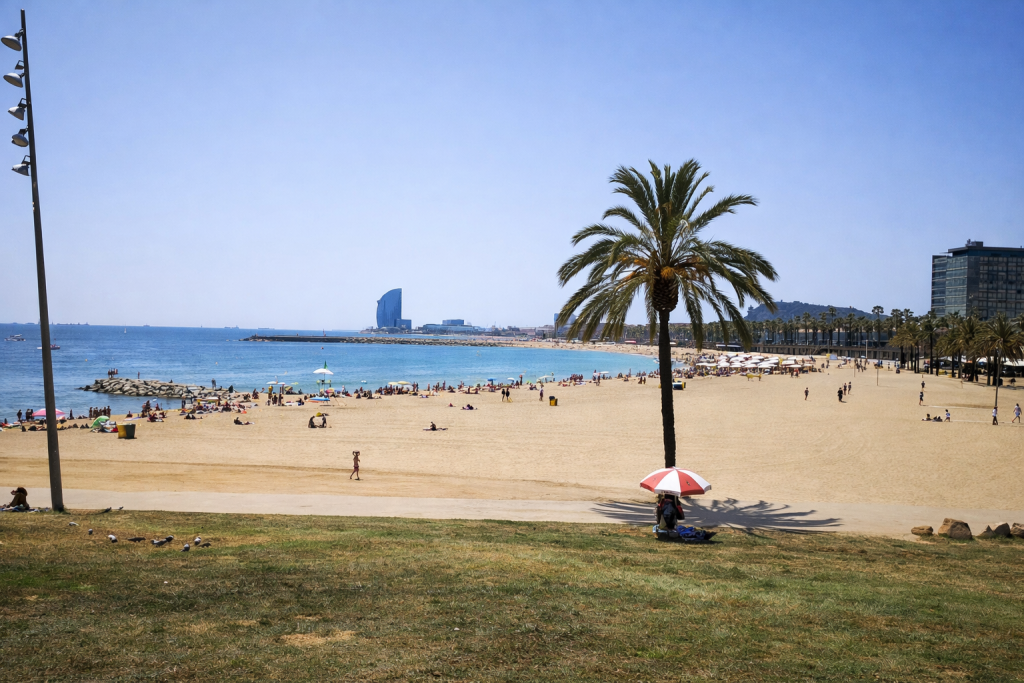
Just across the point from Ses Illetes, Playa de Llevant opens into a longer, more spacious stretch of sand with far fewer surrounding boats. Approaching by yacht, you see a long, uninterrupted stretch of pale sand with wide, exposed sea on one side and Formentera’s low landscape behind it.
By land, it attracts fewer visitors than Illetes. By boat, it offers more breathing room. You anchor in clear water with fewer surrounding yachts, giving it a more relaxed and spacious feel while still enjoying the same bright turquoise tones that make Formentera famous.
Playa de Llevant feels noticeably quieter than neighbouring Ses Illetes. It attracts charter yachts and day boats looking for space rather than a scene, with a calm, understated energy throughout the day. The setting is more natural and open, with fewer organised beach club structures along the shoreline.
There are limited formal beach club venues here, which reinforces Llevant’s positioning as a quieter, swim-focused alternative rather than a dining-led stop.
Water & Swimming
The water clarity is excellent, similar to Illetes, with sandy seabed and shallow turquoise patches closer to shore.
Depth typically ranges from 4 to 9 metres depending on positioning. The open exposure can mean slightly more movement than the sheltered side of Illetes, but in settled weather it remains ideal for swimming and paddleboarding.
When to Visit
Late morning is ideal before wind and traffic increase. In peak summer afternoons, the open side can become slightly choppier depending on conditions.
It works well as either an alternative to Illetes when that anchorage is busy, or as a secondary stop for a quieter swim.
If Illetes looks too crowded, cruise around the point to Llevant for more space while keeping the same water quality.
Llevant combines easily with Ses Illetes and Cala Saona, giving you multiple Formentera stops within a single, well-paced island-hopping charter.
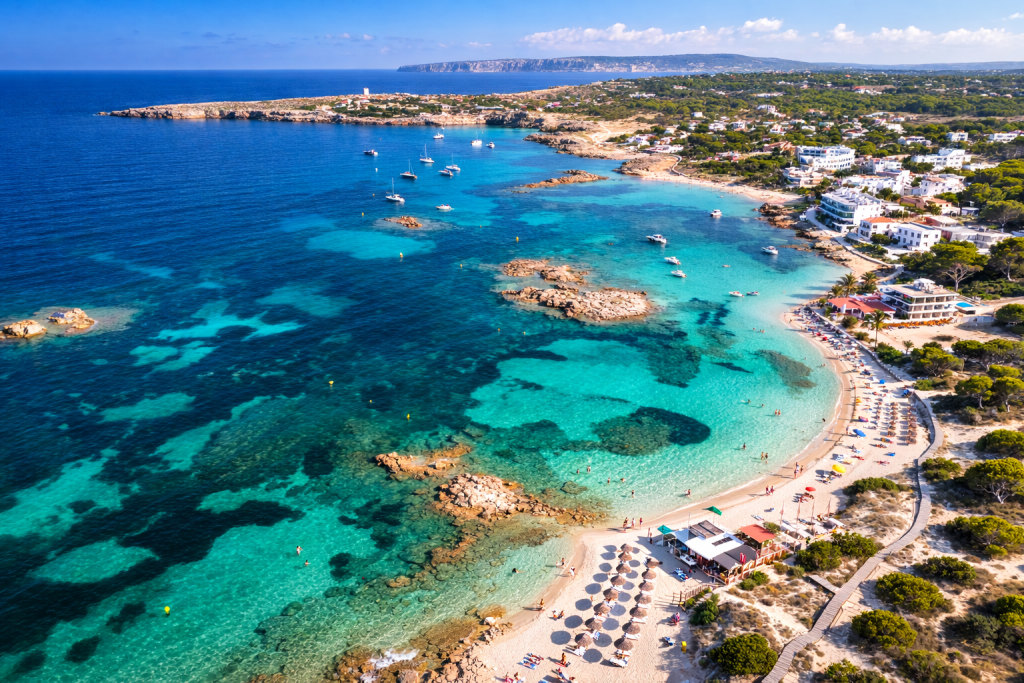
Anchoring off Es Pujols brings you closer to one of Formentera’s livelier waterfront hubs, where swimming and dining combine easily in one stop. As you approach by yacht, the coastline feels more developed, with a small resort town behind a series of rocky inlets and sandy sections. It blends natural water colour with a livelier shoreline backdrop.
By land, Es Pujols is one of Formentera’s main hubs. By boat, you anchor just offshore in clear water while still having easy access to restaurants and waterfront spots. It works well as a stop that combines swimming with a walk ashore.
Es Pujols has a more animated, harbour-style feel compared to Cala Saona or Llevant. It attracts a mix of island visitors and charter guests stopping for lunch ashore, with a relaxed but social energy during the day. It feels livelier than the more natural anchorages, yet still far calmer than Ibiza’s beach club hotspots.
Waterfront restaurants such as Chezz Gerdi line the shoreline, positioning Es Pujols as a convenient and well-established lunch stop rather than a pure swim anchorage.
The water remains very clear, though the seabed can be a mix of sand and rock depending on positioning. You need to anchor carefully to avoid protected seagrass areas.
Depth generally ranges between 5 and 10 metres in common anchoring zones. Swimming is comfortable, with several small coves along the shoreline to explore by tender.
Late morning or early afternoon works best if you want to combine anchoring with lunch ashore.
It is less about sunset and more about daytime atmosphere. If you are planning a relaxed return to Ibiza, this works well as a final Formentera stop before heading back.
Es Pujols pairs well with Ses Illetes earlier in the day, giving you a mix of pristine white sand and a more social harbour-style stop before cruising back across to Ibiza.
Seeing the beaches listed individually is useful. Experiencing them in the right sequence is what makes a charter day flow properly.
Below are two example routes, one focused on Ibiza’s west coast and one combining Ibiza with Formentera.
Morning – Cala Salada
Start the day in calmer conditions at Cala Salada. The water is often flatter in the morning, making it ideal for your first swim and paddleboard session before traffic builds.
Midday – Cala Bassa
Cruise south towards Cala Bassa for a relaxed anchorage and lunch stop. Anchor in sandy holding and tender ashore if you have a reservation at CBbC.
Afternoon – Cala Conta
Continue along the west coast and reposition for Cala Conta. Swim, relax and enjoy the open views towards the small offshore islets.
Golden Hour – Es Vedrà Cruise-By
Finish with a slow cruise past Es Vedrà as the light softens. This is one of the most iconic sunset backdrops in Ibiza.
Return to Port – Early Evening
Cruise back towards Ibiza Town with sunset behind you.
Why this works:
It builds gradually from calm swim stop to lunch anchorage to dramatic sunset.
Morning – Ses Salines
Short south-coast cruise for a warm-up swim in open water before crossing to Formentera.
Late Morning – Ses Illetes (Formentera)
Anchor in shallow turquoise water. Swim, relax and prepare for lunch ashore if reserved.
Lunch – Juan y Andrea or Beso Beach (Formentera)
Tender ashore for a long, structured lunch.
Afternoon – Cala Saona
Cruise around the west side of Formentera for a more protected, scenic swim stop framed by red cliffs.
Return Leg – Cala Jondal or Direct Cruise Back
On the way back, stop at Cala Jondal for a late drink if time allows, or enjoy an open-water sunset cruise back to Ibiza.
Why this works:
You experience both islands, contrasting shallow white-sand anchorages with dramatic Ibiza coastline in one seamless day.
Ibiza and Formentera are islands of contrast. In a single day, you can move from quiet turquoise anchorages to lively beach lunches, from shallow white sandbanks to dramatic cliffside landmarks. The difference is not just where you go, but how you arrive.
By yacht, there is no rush between stops, no fixed schedule dictated by roads or reservations you can’t reach in time. You anchor where it feels right, swim when the water looks inviting, extend lunch if the atmosphere suits, or reposition for a better sunset.
Experiencing both islands properly requires flexibility, local knowledge and the freedom to adapt the route as the day unfolds. A private charter gives you that control, allowing the itinerary to shape itself around conditions, preferences and timing rather than the other way around.
If you’re planning time in Ibiza or Formentera, consider what you want the day to feel like. Relaxed and swim-focused, social and lunch-led, or scenic with a sunset finish. The right yacht and route simply bring it all together.
